Publishing internships & scholarships available to Ball State writers
Posted: March 5, 2013 Filed under: Attend/Organize Literary Events | Tags: Ball State, Discovery Group, English Department, internship, Midwest Writers Workshop, publishing, scholarship 3 Comments
Did you know there’s a writers’ conference in Muncie, Indiana?
Well, now you do.
Thanks to a grant from the Discovery Group, Ball State students can 1.) intern at or 2.) attend this summer’s Midwest Writer’s Workshop, a yearly gathering of agents, editors, publishing professionals, and writers whose mission is to help Midwesterners become published authors. Participants can gain real-world experience and build the kind of credentials that will give them an advantage in their careers.
To get this kind of experience as a college student is unusual. To get it as a college student not in New York City but in Muncie, Indiana is amazing.
There are up to 15 internship spots available. Find out more here: Discovery 2013 Internship
There are up to 10 scholarships available: Find out more here: Midwest Writers Workshop Scholarship.
The deadline for applications in Friday, March 29, 2013 at noon. THE DEADLINE HAS PASSED!
For more information, please talk to the Project Director, Prof. Cathy Day of the English Department at cday ((at)) bsu *d-o-t* edu.
Please note:
- Even if you don’t get a scholarship, you can still register to attend the conference. It’s very affordable.
- The internships are for ANY Ball State student, regardless of major. The scholarships are for English majors.
- Graduate students can apply for both of these opportunities.
- Students graduating May 2013 are eligible.
- The 5-page writing sample for the scholarships doesn’t have to be a self-contained piece. It can be the first 5 pages of a 10-page story or a 200-page novel.
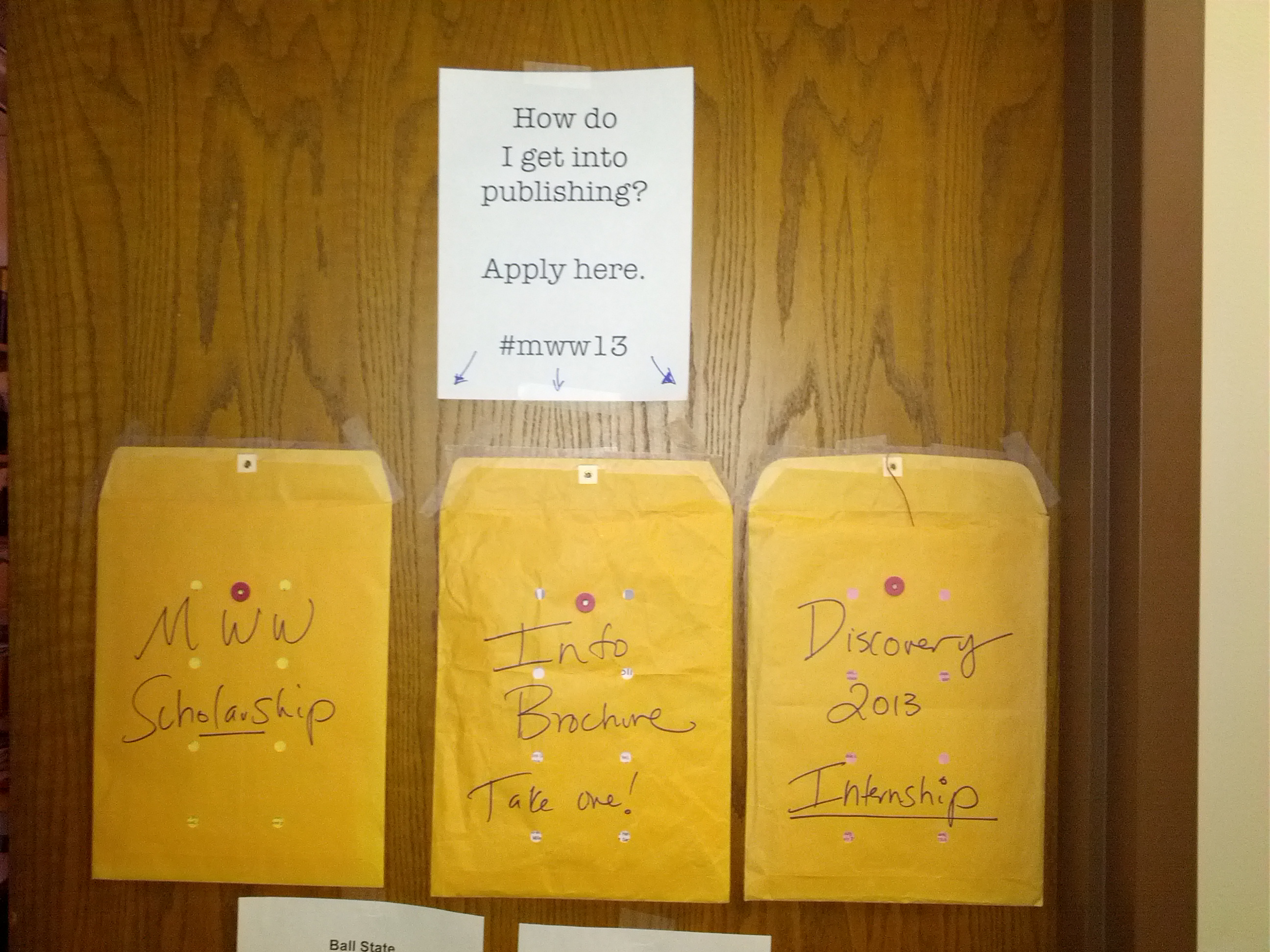
You can also grab applications off her office door, 266 Robert Bell!
Can I get 100 AWP members to vote in this election? HOW ABOUT 1000?
Posted: March 2, 2013 Filed under: Online Community | Tags: AWP, jill christman 7 Comments
AWP is huge. 60% of this enormous community needs to vote. Let’s do it.
Cathy Day here. If you teach creative writing at an AWP-member school, pay attention. I know you’re busy, but take a minute and vote in the AWP election. President Steve Heller spells it out here:
“We must muster a quorum to address our association’s regular lack of a quorum. Perhaps this is the inevitable quandary of having an association of independent thinkers, a corporation of writers and teachers.”
Translation: because AWP has gotten so big, its governance system needs updated. But to make a change, 60% of members have to vote.
Better translation, from AWP board member Anna Leahy:

Got that? If you don’t vote, lawyers will get AWP’s money instead of writers. That’s the best reason yet, people!
60%! That’s going to take a big push, people.
I voted a few weeks ago, but this thing’s not going to fly unless I can get–I don’t know–100 other people to vote. And they get people to vote.
So: let’s use social media to do some good and start bugging people!
Who’s eligible to vote?
- program directors of institutional member programs (like my boss Mark Neely, who directs Ball State’s creative writing program)
- directors of WC&C member programs (like the director of the Sewanee Writers’ Conference)
- faculty at institutional member programs (like me and half my Facebook friends)
- independent members who have joined at non-student rates
So: not students.
To check your membership status, visit My AWP Account.
Go here to vote.
Another good reason to vote (other than this One-Time Quorum-Because-Getting-a-Quorum-Regularly-is-Impossible thing) I know two people who are running as representatives, my BSU colleague Jill Christman (read her kick-butt statement here, even if you don’t live in the Midwest) and my pedagogy buddy Anna Leahy who teaches at Chapman (read her awesome statement here).
After you vote:
- Leave a comment here.
- Tweet “I voted in the AWP election. I’m a #litcitizen” and I’ll see it.
- Share this link on Facebook and rouse YOUR friends into a voting frenzy.
Thanks, and may the force be with you.
Graduate School for Creative Writers
Posted: February 24, 2013 Filed under: Attend/Organize Literary Events | Tags: BallState, graduate school, MFA, PhD in Creative Writing 9 Comments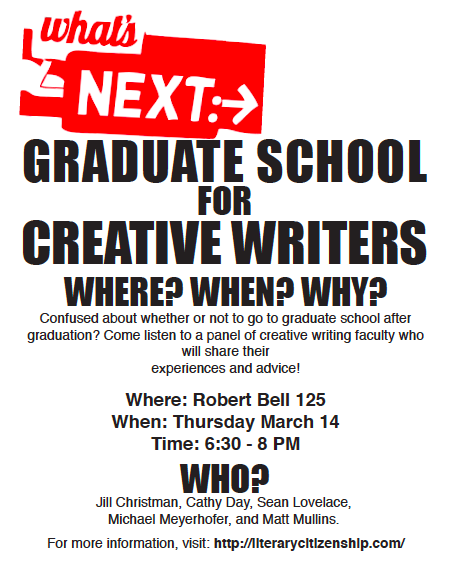
See you there!
[Here’s a link to the transcript of what we talked about on 3/14/13 at the panel, in case you missed it!]
Links and Resources
Before, during, or after the event, feel free to check out these links and resources:
- “MFA Bound” by Prof. Liz Whiteacre–download this!
- “When People Ask Me About Applying to MFA Programs” by Prof. Cathy Day–ditto.
- “Advice on Choosing a Program” by AWP
- “Low-Res, High Motivation: An Interview with Jill Christman” by Cathy Day
- “Ten Tips for Those Considering MFA Programs” by Ilana Stanger
- The Creative Writing MFA Blog.
- “So You Want to Get an MFA?: An Open Letter to My Students” by Stephanie Vanderslice. The Huffington Post
- “Why Critics of MFA Programs Have it Wrong” by Curtis Sittenfeld and Lan Samantha Chang. Salon
- “MFA Fever.” The Chronicle of Higher Education.
- The Creative Writing MFA Handbook: A Guide for Prospective Graduate Students by Tom Kealey
- “MFA FAQ: The LOR” by Cathy Day
- “Write Tip: Getting Letters of Recommendation” by Tayari Jones
- “Statement of Purpose: Do’s and Don’ts” by Cathy Day
- “2012 MFA Rankings: the Top Fifty” by Poets & Writers magazine. Use this as a starting place. The rankings themselves are highly controversial.
- “Portraits from MFA Nation” by Poets and Writers magazine.
- “Post-MFA Advice” by Lee Martin
- Reality Check: Why do you want an MFA in Creative Writing? by Adam Atkinson
This event was organized by the students in Cathy Day’s Literary Citizenship class at Ball State University. And here’s a picture of the event!
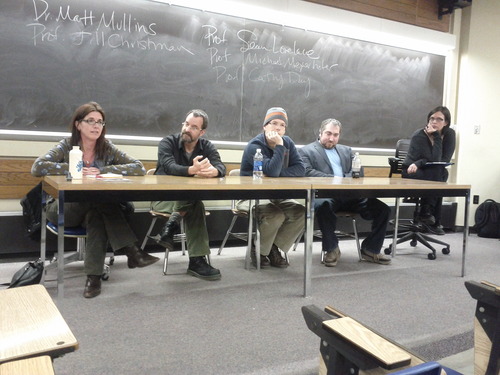
l to r: Jill Christman, Matt Mullins, Sean Lovelace, Michael Meyerhofer, Cathy Day. Photo by Rachael Heffner
The Art of the Book Review
Posted: February 20, 2013 Filed under: Guest Posts, Write Book Reviews 3 CommentsHere’s a great roundup about the art of book reviewing. This is what I really want my students to understand: that to REALLY review a book is to embrace a new art form with seriousness of purpose and a commitment to do it well.

I just got off the phone with my friend, L. Marie, who recently created a blog, “Thoughts about writing and life.” I’m thrilled that she’s blogging! We chatted about Literary Citizenship and how she needs this online presence in order to impress the agents where she’s currently shopping her young adult fantasy book. She has an MFA and is a terrific writer—but she realized that she needed to get online and join the literary world. I talked to her all about what we’re doing in our class; we talked through WordPress and how to add hyperlinks and tags. She’s on a roll now!
She’s also an avid reader, so I encouraged her to do reviews of books (her current blog is a movie review that ties into her writing). And wouldn’t you know it, our Lit Cit class is talking about that very topic this week. Book reviews are…
View original post 975 more words
How to Talk to Writers
Posted: February 20, 2013 Filed under: Online Community | Tags: Bonnie Rough, Carolyn See, Charming Notes, Rachel Fershleiser, Social Media 8 Comments
“Stay in touch!”
A key principle of literary citizenship is that writers should build their community and expand their circles.
Not “network.” Not “schmooze.”
In her book Living a Literary Life, Carolyn See advises writers to send one “charming note” a day to someone in the publishing field—a writer, editor, publisher, etc. The point isn’t to ask for anything, but rather to just make a connection. These days, thanks to social media, it’s never been so easy to make those kinds of connections.
I require my students to friend or follow or email someone five times a week. Friending on Facebook, liking an Author Page, following on Twitter: these are “passive” acts. But at least once a week, they’re supposed to actually say something to somebody. Such as “I enjoy your work,” or “You published one of my favorite books,” etc.
The English Major’s Dream Job: Book Reviewing Advice from David Walton
Posted: February 12, 2013 Filed under: Interview Writers, Write Book Reviews | Tags: Book Reviews, David Walton, John Updike, Rebecca Skloot 7 Comments
David Walton, author of Ride, reviewer of many, many books.
God knows, the world needs more book reviewers.
A key principle of Literary Citizenship is that it’s important to talk up (informally) or review (formally) the books you like. Start with your personal network and work up to Goodreads and Amazon.com. Review books on your blog. Maybe even work toward reviewing for newspapers and magazines, print or online. Robin Becker at Penn State and Irina Reyn at Pitt are just two people I know of who actively teach their students how to write and publish book reviews.
Now, I’ve never been much of a book reviewer, but I know people who are.
Like my friend, the writer/critic David Walton. He’s the author of the novel Ride and a former winner of the Flannery O’Connor Prize for Short Fiction. He’s also a prolific book reviewer for such places as the New York Times Book Review and the Dallas Morning News, among others.
[Also: this gave me an excuse to write to him. Because he’s one of the things I miss most about Pittsburgh.]
Q: Dave, I’ve shared John Updike’s six rules for book reviewers with my students, as well as this incredibly informative article by Rebecca Skloot about how to break in as a book reviewer. What my students need from you are the very basics.
Well, some of this is standard.
- Full title and full author name early, if possible in the first paragraph, even though it’s in the heading.
- Something about the author, but not much.
- Give away no important plot point, and nothing after the first 50 or 100 pages.
- Make sure you have a quote or two–a sample of the author’s style.
- You need a lede and a walk-off, an opening that overviews the book and a conclusion that leaves a final impression, final point–and for me is usually something specific, a detail from the book, less than an overview or judgment.
- Avoid conflicts of interest (no reviewing of friends, enemies, former professors, etc.)
But really, the book itself shapes the review.
Q: How long should a review be?
Word limits are strict. 450-500 words. It used to be 500-600, but 450 is preferred, and I try to aim for that. That means you have to be compressed in what you say, and very definite.
I usually write 500+ then pare down.
Q: Oh, gentle reader, to give you a sense of how many words that is, I should mention that you have now reached word 430 in this post.
Writing a polished review is a demanding writing exercise. It takes me two days to get those 450 words. Sometimes I labor over an opening paragraph or two for a couple of hours, then pitch it out. And believe me, there’s a lot to check in 450 words–use the word excellent twice, or any word, and it stands out.

“Showing off” 20%
Q: Do you review books you don’t like?
My feeling is that you review books you like, and the review’s job is to sell the book. There are so many books, why give attention to a bad book? Readers read reviews to spot books they want to read. That’s my feeling. However, established writers can be knocked and savaged, when they deserve it.
Q: Why do you do it?
Why do I review books? Because I like to read. I mostly review history and bioraphy, and usually single out subjects I don’t know much about. Right now I’m reviewing a history of the tenth century. I can’t think of a subject more remote from my interests–but every period of history has its interest, and every good book is an enlargement, even if it doesn’t fit into your category of expertise. Especially if it doesn’t fit into your existing category of expertise, but gives you, as a book should, a new perspective, a set of experiences you would not otherwise have had.
Also, I like to see my name in print. Through lean years of output and publication, I’ve been able to consider myself a writer. My words are in newspapers all over Dallas, or Cleveland, or Louisville, Kansas City, with my name above them.
Partly for the money, too, believe it or not. Newspapers don’t pay much for a review, maybe a couple of hundred at best. More often less, much less. It adds up if you can publish a review in more than one place, but that takes patience and finesse. Most editors want to run their reviews first. And newspapers, and newspaper space, shrink year by year.
Q: What my students want to know is “Can I make a living at it?”
No, probably not. Reviewing can be a drain. It pays little. It takes time from other things. But it instills the standards that are important in all writing: economy, precision, a sense of order and clear purpose. And lastly: most of us are English majors, and isn’t it the dream of the English major to be paid for reading–that solitary pursuit that for years took us away from play and chores, that got us labelled as idlers and dropouts and solitaries? And here at last, even if only for a rate I figure out to be about 35 cents an hour, to be paid for it. It’s too good to pass up.
Some years ago I might send a review to eight or ten papers, but many of them are gone now, or don’t publish reviews anymore, or have had their freelancer budget cut to nothing. But for years reviewing sustained me, some of them very lean years, and I’ve gained immeasurably from working with gifted and sensitive editors, who cared about books, and nurtured writers and reviewers–especially local writers–in ways that advanced them. In many ways the book editor of an important newspaper can nourish and advance a fledgling writer. Many of the old practices and standards, and safeguards, of the publishing business have gone by the wayside over these past decades, at the same as the newspaper business has shrunk, and newspapers and publishing houses have gutted their staffs of editors, proofreaders, fact checkers. Reviewing books is an important part of a writer’s community, and grows more important as you grow in prominence.
Q: What’s hard for me to talk to my students about is why book reviews matter–and by this I mean formal reviews, book criticism. They’re undergraduates. They don’t want to think of themselves as “critics.” They don’t read the NYTBR. They might pick up Scott Turow’s Innocent and see a snippet of your review from the Dallas Morning News and have no idea how that snippet got there, why it matters that it’s there.
Because of the decline of a strong publishing apparatus, and a healthy spirit of review and criticism in the daily press, writers must fall back more on their own immediate community of friends, fellow writers, and direct readership on line. Hurt especially are those levels of first and middle list authors who require time and close editorial guidance to become grow, and find their readership.
Book reviewing is a huge subject–and an important one. On the right sidebar, I’ve archived MANY articles about this topic. The Giraldi thing. The good reviews for hire thing. Check them out. If there’s something you think I should know about, please, pass it on!
Jackson Eflin’s Footnotes
Posted: February 7, 2013 Filed under: Write Book Reviews | Tags: Ben H. Winter, Book Reviews, Jackson Eflin, Michael Poore Leave a comment
Over on his blog Footnotes, Jackson Eflin talks up books his likes–with plenty of footnotes.
Michael Poore, Up Jumped the Devil.
Ben H. Winters, The Last Policeman.
Posted: February 7, 2013 Filed under: Write Book Reviews Leave a comment
Sarah Hollowell would REALLY like you to read this book.
Posted: February 7, 2013 Filed under: Buy Books, Online Community, Uncategorized Leave a comment
Austin Hayden discovers Scott McClanahan. That’s definitely something worth writing about.
On Writers Without Websites
Posted: February 5, 2013 Filed under: Online Community | Tags: blogging, Social Media, websites Leave a comment
[This is cross posted here and on my blog, The Big Thing.]
My husband and I have started a little website business, of sorts. We’re not looking to build or expand, mind you. We have one client, my yoga teacher/massage therapist. I’ll call her Violet. She runs a studio out of her lovely historic home. I go there a few times a week and do yoga in her dining room and get acupressure massages in a little room off the kitchen. Violet’s been doing this work for over 30 years, and working with her has made a big difference in my life.
The Findability of Violet
I only found Violet because a friend of mine, Nancy, introduced me. I would never have found Violet on my own. There would have been no way to find her.
See, I knew Nancy did yoga, but I didn’t know where. So I Googled “Yoga Muncie.” This made me very depressed.
Go ahead. Try it.
 One day I was walking home from the bus station and saw a sign in a storefront window of women doing yoga postures.
A yoga studio?! Three blocks from my house?! Hooray!
But as I got closer, I saw that the sign was advertising “the Christian alternative to yoga.”
Really? Really!?
This made me even more depressed.
But finally, I ran into Nancy and said, “Hey, I had back surgery. I’ve gotta get back into yoga.” And so she took me to one of Violet’s classes. I don’t know how I would have found Violet’s house otherwise, or known when to show up, etc.
See, Violet doesn’t have a website.
She does have a phone number and an email address, but obviously, since she’s teaching yoga classes or giving massages all day long, you have to leave a message.
When are her yoga classes? You can’t look it up on her website, so you wait for her to call or email you back. Which she does of course, as promptly as she can.
She’ll add you to her email list, and that’s the only way for you to find out that she can’t do Wednesday’s class this week, but she’ll be back next week, and next month, she’s having a yoga retreat, etc.
What I’m trying to say is that I desperately needed Violet to get a website and start communicating with me more effectively. But this is a hard thing to say to the woman who’s palpating your psoas muscle.
Bartering
But one day, I finally did it. Shortly after creating the website for my Literary Citizenship class, I asked her if she’d be interested in letting my husband and I make her a website in exchange for some massages and yoga classes?
She said yes.
We met with her and got a sense of what she needed her website to do. The different hats she wears. The big picture. We went home, and I told my husband, “You start and I’ll take a look at it.”
A few days later, he showed me the theme he’d picked out.
“Why would you pick that theme?” I asked.
“It’s good for images,” he said.
“Exactly.”
“Isn’t that good?”
“No,” I said. “You don’t go to her page to look at pictures. You want information.”
[Then we had a fight. I’ll spare you the details.]
The next day, I went through the WordPress themes and picked ones in which:
- The name of Violet’s business would be big, prominent.
- The navigation menu would be the first thing you saw, as if to say, “Are you here for Yoga reasons, Bodywork reasons, Food reasons, or Retreat reasons? Click here.”
- Then you’d see Violet. Because after all, she is owner, sole proprietor, and only employee. You’d see her phone number and email address, as well as her impressive bio.
- The next thing you’d see would be her calendar.
- Then you’d see a Google maps widget so you’d literally know how to find her house.
I built the pages and the architecture in one hour. I’m a client. I knew exactly what someone would come to her website wanting to know.
Why did I expect my husband to know this? I have no idea.
Being a Small-Business Owner
Being a writer or artist means you’re the owner of a small business called Being Yourself.
That’s what finally got me over my technology hump, actually. My aversion to having a web presence. I thought about all the businesses that drive me crazy because they won’t adapt. The ones you can’t Google and find out when they open or where they are or what they’re like. The ones you want to recommend to your friend, but there’s no link to share, no page to like. You can’t use a credit card there. They have a sale, and you never hear about it. Everything about this business is hard, and you stop going because God help us, you need something easy.

Websites are like airports. Good ones anticipate your needs and why you’re there and route you where you need to be. They’re easy to find, easy to leave. They piss you off as little as possible. They’re aesthetically pleasing.
I told Violet not to be afraid of technology. “You’re just making it easier for more people to find you. Which means you can help more people. And that’s a good thing.”
Getting to the Point: Writers Without Websites
I know a lot of writers who won’t go online, or will only do it in very limited, very guarded ways. I keep a list of them in my head: Writers I Wish More People Knew About.
Maybe they can’t afford a website. Maybe they think social media is evil. Maybe they think they shouldn’t have to do this work, or they think they don’t have time, or maybe they simply don’t want to.
Seriously, if you know a writer nobody knows about because they’re not online, offer to help them. Show them. Barter with them.
Believe it or not, there was a time when the very idea that I needed to own cathyday.com and blog and update and Tweet filled me with rage. God, how I resented what publishers expected of me, what you, gentle reader, expected from me.
Now, I can’t imagine my life otherwise.
 Literary Citizenship